The election results stimulated myriad projections for change about the political and economic future, but at the foundational levels of society, marriage and worship, nothing changed this past week.
Political elections are about who gets to control the instruments of power. But the fundamental work of rebuilding society from the ground up --- restoring marriage and turning back to worshipping God weekly --- remains in a realm beyond the instrumental tools of government. These fundamentals, so necessary for a functional society, remain untouched by the elections.
And yet the need to change these fundamentals is critical if the goods of politics are to bear fruit. Otherwise it is all for naught in the medium to long term. One good revolution (French, Russian, Chinese or Cambodian) can wipe out a lot overnight.
Marriage and religious practice are all about “belonging” --- belonging to spouse and children and to God. But belonging is not something we can manufacture for others, and it certainly is not something government can distribute, transfer or manufacture. Belonging is the result of attraction --- a fulfilled two-way attraction. However, and this is key, it can start as a one-way attraction. Many a brave man has proven this by wooing, and eventually winning, the reluctant woman of his dreams. “Faint heart never won fair lady.” She gradually came to see how attractive he really was. But no man (not even the most radical of progressives) has ever turned to government to help him be more attractive to the woman of his dreams. So to where and to whom do we turn for this rebuilding, this “sine qua non” of social policy, if not to government? Is not social policy all about government?
This is the fundamental political question for all who want to see society get back on track. Donald Trump can wield political instruments that will affect the economy, the army, medicine and even education (to a degree), but neither he nor his cabinet can improve marriage or levels of worship through policy initiatives. Yet, of all aspects of the United States, these are the “infrastructure” that needs rebuilding.
This family belonging, which is only full of its power when it means marital belonging between mother and father, is the glue that holds society together. This lies, not in the realm of government (except to protect or destroy), but in the realm of “the people”. Belonging is beyond the reach or competence of government. Sure, big government can do and has done lots to wreck it--as in abortion, in sex education that undermines chastity and marriage, in laws that removed restraints on sex outside of marriage, or in liberal Supreme Courts, such as one that would have occurred under Hillary Clinton, that injects such principles into the legal system. But the work of rebuilding lies in the heart of the citizen, not in the powers of government.
The social infrastructure of every inner city needs to be rebuilt. It depends on the capacity of millennials to stay married, to grow when adversity hits a marriage so that they mature into strong adults rather than wimp into a rejection that damages their children. Who can do that? Certainly not the instruments of government.
We can only turn to ourselves, and within ourselves to God. We either attract others to chastity, marriage and worship or we repel them. We are all either walking advertisements for marriage or effective propaganda against it. People expect a deep joy (even in painful times --- especially in painful times) from marriage and family: we either deliver on this in our personal lives or we don’t. Belonging is caught by contact, by seeing it, by experiencing it up close. By being invited in.
Belonging is a very different social policy paradigm, but it is the only one that works.

Website

Showing posts with label family. Show all posts
Showing posts with label family. Show all posts
Tuesday, November 15, 2016

Friday, July 31, 2015
Kids Count…Marriage Counts.
The Annie E. Casey Foundation (AECF) recently released its 2015 edition of Kids Count. This important annual study examines how the well-being of children changed between 2008 and 2013 in four areas: economic well-being, education, health, and family and community. To get a fuller picture of child well-being, MARRI believes one must include family structure.
For children, the first aspect of well-being is their family and whether it is intact or not. Nothing shapes a child’s destiny as does her family. MARRI research has shown that children raised in single-parent families, as opposed to intact married families, are less likely to receive a high school degree. Likewise, children who experience parental divorce or separation are more likely to have health problems than those in intact married families. Those who grow up in non-intact married families are much more likely to be divorced or separated as adults than those who grew up in intact married families. And children from married, two parent families experience greater economic well-being than children raised in any other family structure, as the AECF report previously cited demonstrates.
Kids Count concludes, “With the right investments, we can provide all families and children with the opportunity to reach their full potential and, in the process, strengthen both our economy and our nation.” MARRI suggests that the most needed investment, for every child, is an always-intact married family.
- Kids Count 2015 shows numerous improvements in child well-being over the last five years, especially in education (reading and math proficiency) and health (declines in teen drug abuse and teen deaths). While these improvements are welcome news, the report also reported several declines.The portion of children in poverty and of children whose parents lack secure employment increased by 4% between 2008 and 2013.
- The proportion of children living in single-parent homes increased from 32% in 2008 to 35% in 2013.
- In 2013, 34% of children in single-parent families were living in poverty verses 11% of children from married families.
For children, the first aspect of well-being is their family and whether it is intact or not. Nothing shapes a child’s destiny as does her family. MARRI research has shown that children raised in single-parent families, as opposed to intact married families, are less likely to receive a high school degree. Likewise, children who experience parental divorce or separation are more likely to have health problems than those in intact married families. Those who grow up in non-intact married families are much more likely to be divorced or separated as adults than those who grew up in intact married families. And children from married, two parent families experience greater economic well-being than children raised in any other family structure, as the AECF report previously cited demonstrates.
Kids Count concludes, “With the right investments, we can provide all families and children with the opportunity to reach their full potential and, in the process, strengthen both our economy and our nation.” MARRI suggests that the most needed investment, for every child, is an always-intact married family.
Thursday, June 25, 2015
Pope Francis: The Family is Key to Our Environment
Marriage and family are the necessary foundations of the road towards a sound ecology and away from environmental degradation, contends Pope Francis in his recent encyclical Laudato Si.
Quick verification test: What major nation is the most abusive of the environment and of children? China, by far on both counts.
In Laudato Si Pope Francis indicates that only by protecting the family, the first environment every child encounters, will society experience effectual progress:
Pope Francis contends that man’s hardened heart, and the society it has produced, has profoundly damaged the environment. While Francis grapples with ecological issues, he primarily laments the decrepit human environment wrought with selfishness, insensitivity, self-gratification, and irreligiosity. As MARRI research has found on so many non-environmental issues such as the economy and health, environmental reform must first address the foundation of all human interaction, the family, “the basic cell of society,” (paragraph 157).
In society today, premarital sex, divorce, and cohabitation have massively depleted our human ecology. In the United States, only 46% of 15- to 17-year-olds have been raised by their married biological parents, and only 17% of black 15- to 17-year-olds have always lived with their married mother and father. At a vulnerable age when children should learn forgiveness, self-control, and love of neighbor, they instead experience rejection from their very own parents.
Although the majority of single and divorced parents selflessly dedicate their lives to ensuring that their children are guided by love of God, love of God’s law, and love of God’s creation, the average child raised in a broken family is deprived of the gifts of life in some way. Slowly but increasingly, recent generations have been made “wound-bearers” by their parents and have to fend for themselves in ways not meant for children. They are being hardened to life and to their surroundings.
But there is hope. A revival of the intact married family will imbue children with the love and care that all children ought to receive in order to reflect it back onto their environment. MARRI data shows that children raised in intact families are more social, exhibit less aggression, and practice better self-control than those in non-intact families, all necessary for salvaging the biological environment.
Quick verification test: What major nation is the most abusive of the environment and of children? China, by far on both counts.
In Laudato Si Pope Francis indicates that only by protecting the family, the first environment every child encounters, will society experience effectual progress:
I would stress the great importance of the family, which is “the place in which life—the gift of God—can be properly welcomed and protected against the many attacks to which it is exposed, and can develop in accordance with what constitutes authentic human growth. In the face of the so-called culture of death, the family is the heart of the culture of life.” In the family we first learn how to show love and respect for life; we are taught the proper use of things, order and cleanliness, respect for the local ecosystem and care for all creatures. In the family we receive an integral education, which enables us to grow harmoniously in personal maturity. In the family we learn to ask without demanding, to say “thank you” as an expression of genuine gratitude for what we have been given, to control our aggressivity and greed, and to ask forgiveness when we have caused harm. These simple gestures of heartfelt courtesy help to create a culture of shared life and respect for our surroundings. (Paragraph 213)
Pope Francis contends that man’s hardened heart, and the society it has produced, has profoundly damaged the environment. While Francis grapples with ecological issues, he primarily laments the decrepit human environment wrought with selfishness, insensitivity, self-gratification, and irreligiosity. As MARRI research has found on so many non-environmental issues such as the economy and health, environmental reform must first address the foundation of all human interaction, the family, “the basic cell of society,” (paragraph 157).
In society today, premarital sex, divorce, and cohabitation have massively depleted our human ecology. In the United States, only 46% of 15- to 17-year-olds have been raised by their married biological parents, and only 17% of black 15- to 17-year-olds have always lived with their married mother and father. At a vulnerable age when children should learn forgiveness, self-control, and love of neighbor, they instead experience rejection from their very own parents.
Although the majority of single and divorced parents selflessly dedicate their lives to ensuring that their children are guided by love of God, love of God’s law, and love of God’s creation, the average child raised in a broken family is deprived of the gifts of life in some way. Slowly but increasingly, recent generations have been made “wound-bearers” by their parents and have to fend for themselves in ways not meant for children. They are being hardened to life and to their surroundings.
But there is hope. A revival of the intact married family will imbue children with the love and care that all children ought to receive in order to reflect it back onto their environment. MARRI data shows that children raised in intact families are more social, exhibit less aggression, and practice better self-control than those in non-intact families, all necessary for salvaging the biological environment.
Thursday, June 18, 2015
East Meets West
By Henry Potrykus
In a previous whitepaper, we described research that shows TV negatively affects family formation and family intactness. Here we want to report on a new, similar study that shows Western television contributes to declining fertility rates.
In “Television Role Models and Fertility—Evidence from a Natural Experiment” two German econometricians looked at the effect of Western German programming on East German family formation over the Cold War.
During the first years of the Cold War, East Germany (GDR) was rather insular. For the purpose of the study it isn’t important if the GDR was behind a physical wall; what matters is that Western TV reception was rigorously streng verboten (forbidden): There were campaigns to tear down West-facing antennae found on East German homes.
With the arrival of the Honecker government in 1971, things changed. Détente arrived. With it came Western TV showing East Germans the ‘Western family ideal’: no kids.
Well, not all of East Germany saw this change. Dresden was a black-out zone - not because Westerners didn’t want to reach it, but because of physics: The signal didn’t propagate all the way over there.
Throughout these changes, East German TV was comparatively pro-child. Though women were still expected to be part of the economic-industrial machine, family was portrayed in a deliberately positive light.
So, we have a natural experiment:
Our German econometricians use the fact that Western TV “turned on” in the GDR in the 1970s, and that it never really got to Dresden, to show that Western TV reduced family size wherever it went.
Although their study is not (yet) as complete as the one we described in the whitepaper, it is another rather clear indicator that our role models out West affect who we become - or don’t become, in this case. They affect us negatively when it comes to the fundamental ordering unit of society: the family.
With these important empirical studies, perhaps that old debate over whether programming affects us (negatively) is closer to settled. Since there is still no shortage of zero-population growth-types around, whether this effect is pejorative may still be controversial. One thing is sure: with the incipient decline of European nations (including Germany), fewer and fewer of their people will hold the opposing view. Double entendre entirely intended.
Friday, June 5, 2015
The Widespread Impact of Marriage on Society
Two weeks ago I made a presentation on The Family as The Agent of Economic Development and the Fundamental Safety Net at a conference at the United Nations that was sponsored by the Holy See’s Permanent Observer Mission, The Pontifical Council for the Family, and The UN Alliance of Civilizations. I set the stage with the framework of the five basic institutions of society: The family, the church, the school, the marketplace, and the government. Each institution has its basic function or task within society; for family it is the sexual, for religion it is reflection, for education it is learning, for the marketplace it is production, and for government it is protection.
The presentation illustrated how society, in each of the five institutions, benefits from marriage. A sample item will serve as a brief synopsis of how marriage influences the economic marketplace.
According to the Survey of Consumer Finance, the median income for the “married always intact” family is $82,270 while their net worth is $546,944. Both figures are substantially higher than any other household structure, whether married step, cohabiting intact, cohabiting step, separated, divorced, widowed, or never married.


Furthermore, when one seeks to discover what the contribution is from marriage to the general tax pool the data show that married couples contribute a staggering 40% more than two single individuals identical in all ways to the married couple even while they benefit from the tax deduction received for being married. More data and analysis on this subject will be released by the Marriage and Religion Research Institute in the coming months.
This doesn’t even begin to look at myriad other impact such as the economic impacts of divorce or the marriage premium effect on male income. But is only a small glimpse of the widespread influence of marriage on the five basic institutions of society. To read the entire presentation or to get a copy of the PowerPoint used during the presentation, please visit http://marri.us/un-holysee.
The presentation illustrated how society, in each of the five institutions, benefits from marriage. A sample item will serve as a brief synopsis of how marriage influences the economic marketplace.
According to the Survey of Consumer Finance, the median income for the “married always intact” family is $82,270 while their net worth is $546,944. Both figures are substantially higher than any other household structure, whether married step, cohabiting intact, cohabiting step, separated, divorced, widowed, or never married.


This doesn’t even begin to look at myriad other impact such as the economic impacts of divorce or the marriage premium effect on male income. But is only a small glimpse of the widespread influence of marriage on the five basic institutions of society. To read the entire presentation or to get a copy of the PowerPoint used during the presentation, please visit http://marri.us/un-holysee.
Friday, May 29, 2015
Sex, Robots, and the Future of the Family
The dystopia in Huxley’s Brave New World is quickly morphing into a terrifying reality. According to the Wall Street Journal, within the next 10-15 years people will have the ability to customize lifelike robots to fulfill their sexual demands. Far from sexual liberation, intercourse with robots will inevitably yield a hedonistic cult of emotionless humans enslaved to their lustful passions and devoid of love or reason. Emotionally and economically, it will radically expedite the crumble of western civilization.
Sexual intercourse with customizable robots is akin to pornography on steroids—it will emotionally destroy human-human relationships and consequently eliminate the very basis of society: marriage. As “The Effects of Pornography on Individuals, Family, and Community” shows, social scientists, clinical psychologists, biologists, and neurologists have all found that pornography distorts sexual relations. Men who habitually look at porn have a higher tolerance for sexual aggression and rape, tend to view women as “sex objects,” and generally experience sexual dissatisfaction. Because pornography is highly addictive, many users fall into sexually compulsive behaviors that render them unable to carry out a meaningful social and work life. Actually having sexual intercourse with a robot will exacerbate the consequences of pornography. Fewer human-human relationships will form because humans are not customizable like robots, and will simply be sexually unfulfilling. At the same time robots will not be sufficient because they lack any emotional connections. The human-human relationships that do form will be unstable because they do not provide the “perfect” physical sexual satisfaction that the robot once provided. Fewer children will be born since a robot cannot beget a child. And children who are artificially conceived will only have one parent (or perhaps one human parent one robotic stepparent?). The days of intellectual and spiritual conversations with your loved one, laughing to the point of tears, or cuddling while watching a movie will be over. Humans will be reduced to an animalistic state of solely fulfilling their appetitive soul. Nay, humans will fare worse—even animals cuddle.
Although it’s not too difficult to understand the emotional deprivations of having sexual intercourse with a robot, the negative economic implications are less apparent. But they are there, and they are extreme. First and foremost, intercourse with robots will deplete stable intact families because it will distort the basis of the family unit: a healthy sexual relationship between a married man and woman. MARRI research repeatedly proves that the intact married family (with a human mother and a human father) is the basis of economic security. “Marriage and Economic Well-Being: The Economy of the Family Rises or Falls with Marriage” shows that the intact married family produces the best economic outcomes of all family structures. On average, married-couple families generate the most income and have the greatest net worth. Poverty rates are significantly higher among cohabiting families and single-parent families than among married families. “The Divorce Revolution Perpetually Reduces U.S. Economic Growth” shows that marriage is a causal agent of economic growth. Specifically, it constitutes one third to one fourth of the human capital that household heads contribute to macroeconomic growth. “Non-Marriage Reduces U.S. Labor Participation: The Abandonment of Marriage Puts America at Risk of a Depression” and “Our Fiscal Crisis: We Cannot Tax, Spend, and Borrow Enough to Substitute for Marriage” explain how marriage protects the economy. Married men have a higher employment rate than unmarried men, and married families produce more children who are equipped with the essential skills to compete in the modern economy. The population shift towards non-marriage causally determines a large share of the decline of the adult male labor participation. Less Labor force participation plus less human capital equals a slowdown of economic growth. A slowdown of economic growth plus an increasing dependency on welfare equals an increasing budget deficit. As sexual intercourse with robots intended for lust replaces sexual relationships with humans intended for building families, economic decline will accelerate.
Simply put, sexual intercourse with robots will emotionally destroy stable human-human relationships that produce intact families; a shortage of intact families will divest the economy of its greatest contributors. Sexual intercourse with robots will corrupt because it will violate the laws of nature and nature’s God; it will dehumanize because it will defy the rational and intellectual capacities of man; it will pervert because it will eliminate love from relationships. Ultimately, sexual intercourse with robots will be fatal because it will destroy the emotional and economic functioning of civilization.
Monday, November 10, 2014
How the Family Protects Against Government Dependency
Newly elected Republican leadership in the House and Senate
is sure to usher in a wave of policy proposals, reforms, and disputes. A
predictably significant debate already underway is the extent to which policy
will encourage self-sufficiency rather than reliance upon government.
Between 2008 and 2011, household participation in government
benefit programs rose from 45.3 percent to 49.2 percent. However, the majority
of Americans favor independence to reliance on the commons (i.e. government re-distribution). Of those polled, 74 percent believe that
Americans are too dependent on government (87 percent of Republicans and 58
percent of Democrats expressed this view).
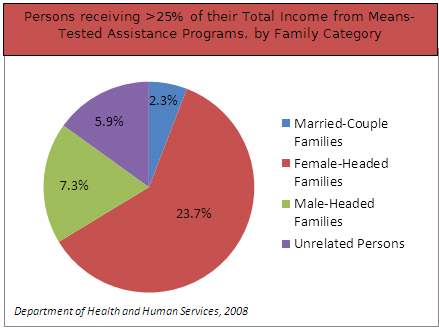
Encouragingly, there is a natural, efficient, and generally bipartisan
remedy that will decrease government reliance and encourage self-sufficiency: the
intact, married family. In 2011, federal and state governments spent over $450
billion on means-tested welfare for low-income families with children. Roughly
three-quarters of this welfare assistance, or $330 billion, went to
single-parent families. Notably, three-fourths of all women applying for
welfare benefits do so because of a disruption of marriage.
For most measures of government dependency, family intactness is the leading
influence (or shares the position of leading influence with the fraction of
adult high school graduates). For instance, more adults in their first marriage
(47 percent) have private health insurance than those who have been always
single (23 percent), cohabit (6 percent), have divorced (10 percent), or have
re-married (13 percent).
The influence of family intactness on independence is
readily apparent in the breakdown of welfare recipients by family structure. Family
intactness in a geographic area has the largest influence on average welfare
transfers in that geographic area. This is not surprising because Temporary
Assistance for Needy Families (TANF) primarily supports low-income women and
their children. Only 16 percent of adult women who receive TANF or welfare are
in their first marriage.
The fraction of intact families in a geographic area also
has the largest influence on average Supplemental Security Income (SSI)
transfers to men aged 25 to 54 (with controls applied for demographics,
education, and earnings). Most men who receive Supplemental Security Income
(SSI) have always been single (52 percent) or are divorced (17 percent).
Social science shows that intact families are more self-reliant
and therefore have more options to direct their own lives; however, non-intact
families are at the mercy of the government..
If the new majority will take the longer term view they will
talk up the for parents, pastors and teachers to work to restore marriage in
the nation for there is little that Congress can do to rebuild marriage (though
there is a lot it can do (and has done) to damage marriage. The rebuilding will
be done mainly by other institutions, but encouragement by leaders will be very
helpful.
Monday, September 29, 2014
Passing the Half Emptier Mark
Marriage was once seen as a permanent bond intended to
promote monogamous love, spousal devotion, and childrearing. Today, however,
many view marriage, or rather its deliberate avoidance, as a means of defying
tradition, asserting feminist ideologies, and/ or avoiding commitment. Perhaps
most alarming, the mainstream public is supportive but ignorant of the
consequences of this shift.
A Pew
Study released Wednesday reveals that 50 percent of adults believe that
society is just as well off if people have priorities other than marriage and
children, whereas only 46 percent believe society is better off if people make
marriage and having children a priority. However, social science data suggests
otherwise. In marriage are contained the five basic institutions—the basic
tasks—of society: family, church, school, marketplace and government. MARRI research has emphasized
the multitude of benefits the intact, married family confers on children as
they learn to value and perform these five fundamental tasks. A few of these
advantages are highlighted below.
Family
Families with either biological or adoptive parents present
have the highest quality of parent-child relationships,
perhaps because marriage enhances an adult’s ability to parent.
Married people are more likely to give and receive support with their parents
and are more likely to consider their parents as means for possible support in
case of an emergency.
Furthermore, those
who marry experience increased commitment and stability. Men raised in married families have more
open, affectionate, and cooperative relationships with the women to whom they
are attracted than do those from divorced families. Correspondingly, married mothers report more
love and intimacy in their romantic/spousal relationships than cohabiting or
single mothers.
Church
A larger fraction of
adults who grew up in an intact married family than from non-intact family
structures attend religious services at least monthly. Those from married
families are less likely to see religion decline in importance in their lives,
less likely to begin attending church less frequently, and less likely to
disassociate themselves from their religious affiliation.
School
Children of married parents are more engaged in school than
children from all other family structures.
Individuals from intact families completed, on average, more years of schooling
and were more likely to graduate from high school and college than were their
peers raised in non-intact families.
High school students in intact families have GPAs 11 percent higher than those
from divorced families.
Marketplace
Intact married families have the largest annual income
and the highest net worth of all
families with children (widowed families excepted). Married couples file less than half of
all income-tax returns, but pay nearly three-quarters of all income taxes. Marriage increases the income of
single African-American women by 81 percent and single white women by 45
percent; African-American men also see an increase in income after marriage.
Government
Crime. Adolescents
from intact families are less delinquent and commit fewer violent acts of
delinquency.
Likewise, a lower fraction of
adults and youths raised in intact families are picked up by police than those
from non-intact families.
Violence and Abuse.
Marriage
is associated with lower rates of domestic violence and abuse, in comparison to
cohabitation.
Correspondingly, Children in intact married families suffer less child abuse
than children from any other family structure. Compared to teenagers from intact families, teenagers from divorced families
are more verbally aggressive and violent toward their romantic partners.
Health.
Married
men and women are also more likely to have health insurance.
A lower fraction of married than widowed, divorced or separated, never-married,
or cohabiting persons have fair to poor health.
Married people are least likely to have mental disorders,
and have higher levels of emotional and psychological well-being than those who
are single, divorced, or cohabiting.
This data indicates that,
contrary to popular opinion, society will not be “just as well off” if marriage
and childrearing is neglected or even rejected. Marriage is the
foundational relationship for all of society, and a prerequisite for a
prosperous nation.
Thinking otherwise, half of
Americans are out of touch with reality.
(For
full citations, please see the MARRI’s synthesis paper “164 Reasons to Marry”)
Tuesday, July 22, 2014
Millennials: a Dilemma for Social Conservatives
Society is a network of relationships between its citizens. Each citizen’s
capacity to relate to others increases or decreases the social cohesiveness and
strength of a nation, and each one of those individual citizens’ capacities to
relate has been significantly shaped by the family which formed them. As any
family therapist will tell you, these family relationships, in turn, are significantly
tied to the relationship between the father and mother of that family. As their
marital relationship goes, so goes the intra-psychic strength and the social
capacity of their children. The marital relationship changes everything in the
family. Multiplied a hundred million times in the U.S., it has a massively
compounding effect on society—for strength or weakness.
Thus, the relationship between the mother and father figures in a
family is the most foundational relationship in society, the “DNA” that
influences all the relationships that emanate from it. How the shopkeeper
responds to his customers, or the professor to her students, is often quite
tied to how they experienced their parents’ marriage. When a marriage breaks
apart, it affects a child’s behavior and relational capacity. When a parental
relationship is never transformed into marriage (e.g, in out-of-wedlock births
or cohabiting households that break up) it alters the child’s social capacity.
Thus, the future of society is structured by the social ordering of
this primary sexual relationship. That is the heart of the culture wars.
Change the DNA of the body, and you change the body by altering its whole
functioning process. Alter the sexual relationship, and you alter everything
else. Political philosophers are very aware of this. Marx and Engels saw this as
absolutely necessary for their massive project: the permanent altering of
society along the lines of their utopian dream.
Others see this connection even if they do not desire the same outcome
as did Marx and Engels. Most bright Millennials understand it. They see that society
has to pay a certain price for the sexual choices permitted to them today —choices
that were not sanctioned in times past. They will even admit and accept that
the innocent children of these sexual acts will have to pay the price. Many are
prepared to see such prices paid, and therein lies the dilemma.
Marx and Engels wanted this sexual restructuring; many Millennials
accept it. Though Millennials are certainly not all Marxists, it hardly
matters: In the cultural and political contest of the day, they will stand
aside and let the coercive liberal state march forward in the direction laid
out by Marx and Engels.
Are we doomed to some form of coercive Marxist state as our future
because of the sexual choices many in our society treasure? Other than widespread
religious conversion, I do not see much potential for change in the right
direction; hence, I invite your comments. Is religious conversion the only
route?
Tuesday, July 1, 2014
The Comparative Health and Sickness of America’s Racial and Ethnic Groups
The National Center for Family and Marriage Research at Bowling Green State University has just issued a research report on the rates of “first marriage” across different racial/ethnic groups. Interestingly, the ranking of those rates closely parallels the cross-racial/ethnic ranking of the Index of Family Belonging (the fraction of 15- to 17-year-olds who have grown up in an intact married family, which has not changed measurably in the last 3 years) published by The Marriage and Religion Research Institute.
Remarkably,
Asians (whose Index of Family Belonging MARRI shows to be 65 percent) enter
marriage at a rate of 6.2 percent (62 per thousand adults) each year. Whites
have an Index of 54 percent, while they have a (first) marriage-entry rate of
51 per thousand adults. Hispanics have an Index of Family Belonging of 41
percent and an entry rate into first marriage of 40 per thousand native-born
Hispanic adults (though the entry into first marriage among immigrant Hispanics
is 60 per thousand immigrant adult Hispanics, illustrating that immigrant
Hispanics are stronger on marriage and family than acculturated Hispanics). Black
Americans have an Index of Family Belonging of 17 percent and an entry rate
into first marriage of 20 per thousand adult Black Americans.
Overall,
the United States presently has an Index of Family Belonging of 46 percent and
an entry rate into first marriage of 45 per thousand adult Americans.
Thus,
the proportion of children who grow up in an intact married family parallels
the rate of entry into first marriage. That the ranking of the cross-racial/ethnic
(childhood) family intactness and marriage entry rates resemble one another makes
sense. It is interesting that the rate of entry into first marriage is markedly
higher amongst immigrant Hispanics than among native-born Hispanics. This pattern
of greater marital and family strength repeats itself across a number of
measures on Hispanic Americans, indicating that America’s cultural influence is
not always a blessing for immigrants, though clearly its material blessings are.
Because
the marriage relationship is foundational to the future strength of the child
when he or she becomes an adult, these data indicate that the next generation
of Asian Americans may be our strongest racial/ethnic group and that they may continue
to outpace other racial/ethnic groups. Sadly, it is likely that African
American children (and, later, adults) will continue to fall further and
further behind those from all other racial/ethnic groups.
Marriage
has a massive and permanent effect on children. No other institution has a
comparable influence on the life and wellbeing of a child. The implications of
the decline of marriage in America have been clear for some time, as a
different Bowling Green report
illustrates, and this means America may weaken into the future, as well, across
myriad critical outcomes that spending alone cannot change. Such compensatory
hopes are the basis of the welfare state. But the first human welfare is a
married mother and father who stay so to raise their children in strength.
Wednesday, March 12, 2014
The People-Forming Institutions: Preparing the Soil
By: Patrick Fagan, MARRI Senior Fellow
Avery Pettway, MARRI Intern

Although there are five basic institutions in society, only three of them are what I call “person-forming”. The marketplace and government function to protect individuals and to provide for goods and services, but they do not function to directly form the individual. It is the family, the church, and the school that shape character, instill moral principles (which are universal and timeless), and which develop the person as a whole. Thus these three institutions serve society in this, the most foundational and critical of its long range tasks. They each play a direct role in the formation of a person as he moves toward adulthood—additionally, the marketplace and government rely on the primacy of these three person-forming institutions in order to have people capable of serving in their economic and citizen roles.
Why are the institutions of family, church, and school able to form an individual while the institutions of marketplace and government are not? The answer profoundly impacts our national discussion about policies and their implications. Even more importantly, as we delve deeply into this question, we can see more clearly what it means to be human.
There is something foundational to human life that the institutions of marketplace and government simply cannot provide: it is the intimate relational formation of a person. People’s deepest need is relational—love, care, affection, and personalized guidance. In the family, a child finds the nurturing intimacy he needs. In the church, he finds the relational intimacy with the divine that speaks to his soul’s questions. In the school, through good relationships with his teachers, he learns how to understand the world in which he will soon act. The marketplace and the government are the institutions through which he can later exercise who he has become through the shaping of his family, church, and school. When it comes to directly forming who he is, however, marketplace and government have significantly less direct impact—though, in their proper context, laws can teach a great deal, and services from the dark side of the economy can corrupt (e.g. pornography).
As we will explore in future blog postings, the consequences are grave if we misunderstand the distinct nature of the person-forming institutions. To return to our farming analogy: it is ignorant and futile for a farmer to expect abundant crops and sustainable returns without first preparing the soil for harvest, planting good seeds, and caring for the land. Failure to do so results in stunted crop growth and insufficient income for the farmer.
Similarly, we must protect the “three sacred spaces” of family, church and school to permit the harmonizing of the person-forming tasks: the family, where the child most deeply develops as a relating and belonging person; the church, where he orients himself to life and its big issues; and the school, where he learns about the world around him and how to make sense of it. As the farming analogy shows, a child’s future productivity and stability depend on the person-forming institutions’ foundational actions. Giving improper weight to the instrumental institutions—or disconnecting the person-forming ones from each other—will lead to societal destabilization (indeed, this is already happening). When families are treasured and intact, when those families worship God weekly, and when schools aid the work of parents in teaching children according to their worldviews: children from such families thrive, and a society made of these families grows in well-being. Such is the task of each generation—of all societies, across the globe. These are universal truths.

Thursday, March 6, 2014
Marital Intentions in Decline
By: Patrick Fagan, MARRI Senior Fellow
Avery Pettway, MARRI Intern
Jonathan Vespa’s study, “Historical Trends in the Marital Intentions of One-Time and Serial Cohabitors,” just published in February’s Journal of Marriage and Family, confirms what many sense: that among current child-bearing aged women attitudes towards marriage have shifted downwards, mainly through the influence of cohabitation, which is increasingly serial.
Vespa finds two compounding associations within present cohabitation trends.
In short, a woman in today’s world entering a cohabiting relationship is less likely to have marital intent, and she is even still more less-likely to have marital intent if she is a serial cohabitant.
Cohabitation used to be an intentional (though relatively uncommon) stepping stone to marriage for women who engaged in it but that switched with women who were born between 1963 and 1967, and the pattern has continued unwaveringly since then.
Bottom line: There is more of a disconnect between sexual intercourse, cohabitation and marriage. Cohabitation is increasingly accepted as an independent entity, and choosing it has nothing to do with expecting marriage or choosing marriage.
Vespa’s study reveals that compared to women in the youngest cohort (born between 1978 and 1982), women in the oldest cohort (born between 1958 and 1962) had odds of having marital intentions that were 1.40 times higher. Such data suggests that America’s cultural assumption that marriage is sexuality’s end goal is dwindling more and more.
This obviously threatens the health (and rate) of marriage and the institution of the family’s person-forming power. As serial cohabitation rises, marital intentions decrease, and the two compound to push marriage even further into the recesses of the American mind, the stable familial space in which children have been consistently and healthily formed for generations will continue to weaken and with it the future America will be similarly weakened. As we are seeing (and as, I predict, we will continue to see), what plagues the family plagues the other foundational social institutions of Church, School, Marketplace, and Government. As marriage becomes more of a mental side note to our sexual practices, relational instability will continue to increase first in the family, followed later by relational instability in the other institutions (as the child grows into them as an adult).
Vespa isolated the increasing disconnect between sexual union and marriage. The country has yet to feel anxious about its effects on the children, their education, the economy and the capacity of our country to govern itself.
Avery Pettway, MARRI Intern
Jonathan Vespa’s study, “Historical Trends in the Marital Intentions of One-Time and Serial Cohabitors,” just published in February’s Journal of Marriage and Family, confirms what many sense: that among current child-bearing aged women attitudes towards marriage have shifted downwards, mainly through the influence of cohabitation, which is increasingly serial.
Vespa finds two compounding associations within present cohabitation trends.
- The downward trend in marital intentions holds steady and is significant even when controlling for serial cohabitation.
- There is an additional negative association between serial cohabitation and decreased marital intentions. Serial cohabitants (a rising percentage of ever-cohabited women) are less likely to enter a cohabiting relationship with plans to marry (to varying degrees, dependent on whether it is the first, second, or third union) than are one-time cohabitants.
In short, a woman in today’s world entering a cohabiting relationship is less likely to have marital intent, and she is even still more less-likely to have marital intent if she is a serial cohabitant.
Cohabitation used to be an intentional (though relatively uncommon) stepping stone to marriage for women who engaged in it but that switched with women who were born between 1963 and 1967, and the pattern has continued unwaveringly since then.
Bottom line: There is more of a disconnect between sexual intercourse, cohabitation and marriage. Cohabitation is increasingly accepted as an independent entity, and choosing it has nothing to do with expecting marriage or choosing marriage.
Vespa’s study reveals that compared to women in the youngest cohort (born between 1978 and 1982), women in the oldest cohort (born between 1958 and 1962) had odds of having marital intentions that were 1.40 times higher. Such data suggests that America’s cultural assumption that marriage is sexuality’s end goal is dwindling more and more.
This obviously threatens the health (and rate) of marriage and the institution of the family’s person-forming power. As serial cohabitation rises, marital intentions decrease, and the two compound to push marriage even further into the recesses of the American mind, the stable familial space in which children have been consistently and healthily formed for generations will continue to weaken and with it the future America will be similarly weakened. As we are seeing (and as, I predict, we will continue to see), what plagues the family plagues the other foundational social institutions of Church, School, Marketplace, and Government. As marriage becomes more of a mental side note to our sexual practices, relational instability will continue to increase first in the family, followed later by relational instability in the other institutions (as the child grows into them as an adult).
Vespa isolated the increasing disconnect between sexual union and marriage. The country has yet to feel anxious about its effects on the children, their education, the economy and the capacity of our country to govern itself.
Tuesday, March 4, 2014
The Basic Tasks of Society
By: Pat Fagan, MARRI Senior Fellow
Joshua Kelsey, MARRI Intern

Joshua Kelsey, MARRI Intern
As is shown in the diagram above, it is helpful to
understand society as a relationship between five basic institutions or the
five fundamental tasks: Family, Church, School, Marketplace, and
Government. Each institution is really a
gathering of people to perform a core task that is essential and irreplaceable.
If all five tasks are well-performed,
society is doing well. If one of them is not engaging properly with its given
task, society begins to limp. If two institutions don’t perform well, society’s
limping gets more pronounced, and so on.
At the base of society lies the family—the begetting and
raising of children, the next generation.
Without this task society will disappear. Because the family is focused on producing the
next generation, it harnesses sexuality for its ultimate end. Because children need the love and care of
both their father and their mother (and thrive better when such is the case),
marriage is the solid foundation. Though
the child comes naturally from sexual union (very little work), marriage comes
only with a lot of work and effort. Since everything else in the society relies on
the strength of the family, marriage is key to the success of society as a
whole. A society is as vibrant as its
fathers and mothers are solidly married. The object of it all is the next generation.
The church (shorthand for all religions—church, synagogue,
mosque) is where man can orient himself to the big questions of existence: Is there right and wrong, life after death, a
creator God? Should I keep my word, love
those in my family, forgive those who hurt me, give to the needy? This is important work and like everything
else in life, the more one works at something the better he does it. Worshiping God in community normally
involves all these aspects of this task of religion. As this blog will illustrate repeatedly, the more people worship the better they do—on every
outcome. This little known finding is so
universal and so powerful that it ought to be commonplace in our national
thinking and discussion. Its object is
the good person.
School (education) is the task of passing on critical
knowledge to the next generation so that they can build upon the knowledge
already gained from previous generations.
Education almost always has two actors: the pupil and the teacher, the
player and the coach. Education is not
confined to the classroom: it goes on, first, foremost and most powerfully, in
the home; it goes on at work; in the cinema; in the library; in the
newspaper. Its objective is passing on
sound knowledge and insights.
These three institutions—family, church and school— are all
“people forming” institutions; they “grow” the person. Their object is the “goodness of each
individual”.
The marketplace is where we meet our physical needs of
shelter, food, and clothing—a most fundamental task, without which we would die.
We gain these physical goods through an exchange
of our labor for the goods we need.
Savings are stored labor of the past (our labor or others’). The more productive labor a nation has, the
more goods it has. Working, and learning
to work productively, is a key task of the family: both for its own continued
existence and for the capacity of the next generation to feed, clothe and
shelter itself. When people refuse to
work, they become dependent on others for their needs—this weakens society and,
ipso facto, reduces the economy.
The government has the task of using force for the good of
society, mainly protecting our freedoms from “bad people”: external enemies of the intruding armies of
attacking nations, or internal enemies who would rob, injure or kill us or our
family or friends. Because both threats
exist, it is the primary job of the government to protect its citizens from
both these evils. Laws lay out what
government considers right and wrong, and it backs this up with the policeman,
the judge, the jail, or even the execution… all manifestations of force, even
the ultimate force of death. For this
reason, our police need to be above reproach, for they alone have the power to
execute on the spot. No other person in
society has this power. The object of government
is to protect its citizenry’s right to do good.
These two institutions, though they have some influence on
the person, are not primarily “people forming institutions”. They are there on behalf of the instruments
needed to live: physical needs and
safety. They are instrumental institutions.
All of these fundamental tasks of society are not only important—they
are irreplaceable. And at the foundation
of them all is the first, the family. Thence
comes the next generation and every actor in every institution. There also are all these basic tasks executed…
family, religion, education, marketplace and government. Thus it is there that the education of the
future citizen in all five tasks begins and is most shaped.
Thus the most important of all tasks is the bringing of the
next generation (the baby) into existence.
Therefore the most important relationship in society is that of the
relationship between father and mother.
The stronger that relationship, the stronger the children (as all the
data continuously illustrate).
The way marriage is structured and carried out determines
the functioning of the rest of society.
The presence or absence of marriage structures the family,
and as family is structured so is society structured—strongly or weakly, in
every institution: the family itself, the church, the school, the marketplace
and the government.
These relationships are as powerful as the laws of physics:
they cannot be denied, overlooked, evaded or cast aside without society
crumbling. Many societies today seem
intent on that pathway, but that is for future blogs and for the data to
illustrate.
This paradigm of the five basic institutions is the
framework within which we will blog on the research MARRI does and that others
of note do. Tune in for continued
education, and join in for continued discourse!
Subscribe to:
Posts (Atom)